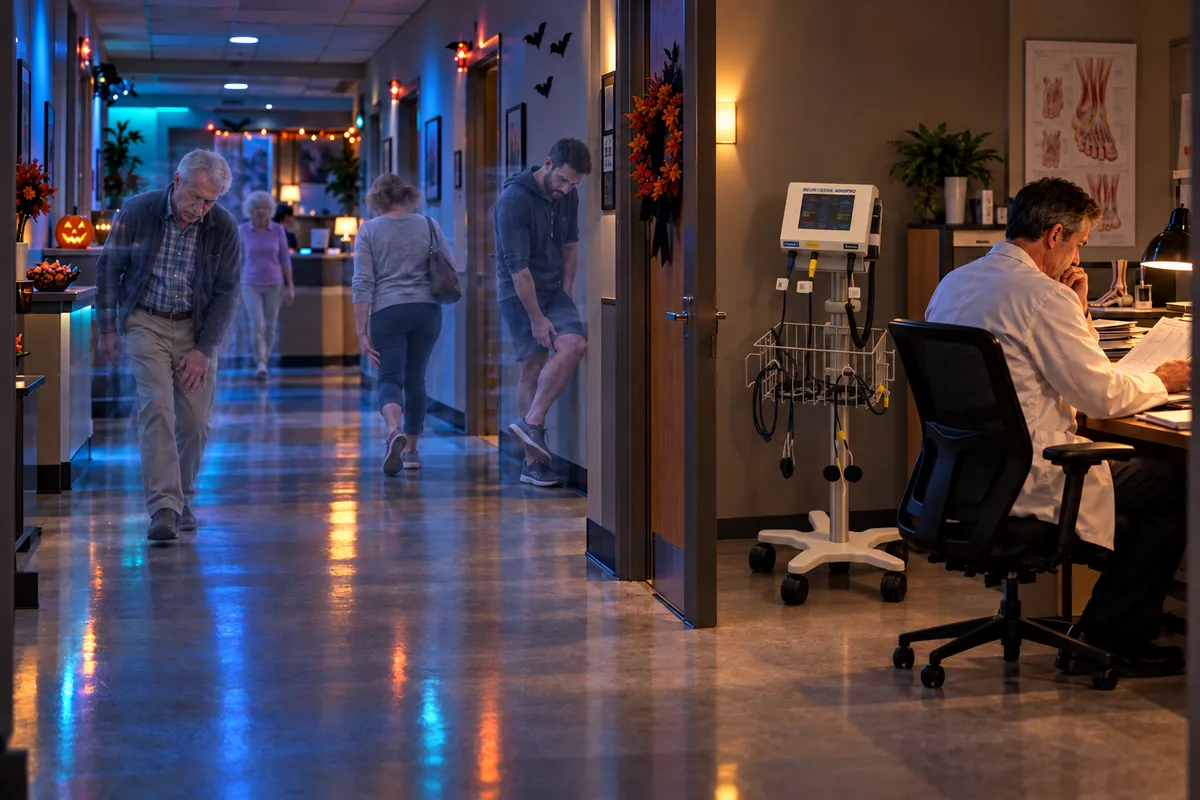
The Ghosts of Neuropathy Patients Past: Is Your Treatment Protocol Haunted by the Same Complaints?
Every podiatrist knows the feeling.
A familiar name appears on tomorrow's schedule.
Before opening the chart, you can almost hear the complaint.
“Doctor, my feet are still burning.”
“The tingling hasn't gone away.”
“I'm still waking up at night because of the pain.”
The patient isn't a ghost. The symptoms are real. And the treatment provided may have been entirely appropriate.
Yet the conversation feels hauntingly familiar.
As Halloween approaches, perhaps the most unsettling thing in an established neuropathy practice isn't something lurking in the shadows.
It's the possibility that the same clinical questions keep returning because the treatment pathway hasn't evolved.
The Ghost of Complaints Past
Some patients return with meaningful improvement. Others require ongoing care because peripheral neuropathy is complex, and symptom control can remain challenging despite appropriate management.
Experienced podiatrists understand this.
But there is a particular kind of déjà vu that deserves attention.
The patient has been evaluated. Contributing conditions have been addressed. Treatment has been adjusted when appropriate. Progress has been monitored.
And still, the same question returns:
“Doctor, what else can we try?”
That question can haunt a practice long after the appointment ends.
Not because the provider has failed.
But because it exposes the limits of what the current treatment pathway may be able to offer that particular patient.
The answer is not necessarily another prescription, another procedure, or another device.
Sometimes, the next appropriate step is diagnostic reassessment, referral, or a clearer discussion of realistic treatment goals.
Other times, it may be worth examining whether an additional treatment modality belongs in the practice's clinical toolkit.
For a deeper look at this recurring challenge, read When Neuropathy Patients Are Still in Pain: Is Your Treatment Pathway Giving You Enough Options?.
The Phantom of the Unchanged Protocol
Here's a slightly spooky thought.
What if the most persistent thing in your neuropathy program isn't the patient's pain—but a treatment pathway that hasn't been reconsidered in years?
Established protocols serve an important purpose. They support consistency, clinical judgment, and appropriate follow-up.
But consistency should not become a spell that prevents reassessment.
When a patient continues to experience burning, tingling, numbness, or nerve-related discomfort, the clinical question is whether the current approach remains appropriate and sufficient.
That includes examining treatment response, tolerability, patient goals, and available alternatives.
A protocol should guide clinical decisions, not haunt them.
And for practices considering an additional modality, the question is not whether the technology is new or intriguing.
It's whether the evidence, authorized indications, patient-selection criteria, and operational requirements justify a place within established care.
Beware the Disappearing Treatment Goals
Not every neuropathy patient is primarily concerned about pain.
Some report diminished sensation. Others describe interrupted sleep, reduced activity tolerance, or difficulty trusting their feet during everyday movement.
And sometimes, the original treatment goal quietly disappears beneath a series of symptom scores.
A patient reports less burning.
But are they sleeping better?
A patient describes less discomfort.
But has their activity tolerance changed?
A patient reports no pain at all.
But what do the sensory findings reveal?
This is where the real mystery begins.
Pain reduction, sensory function, and balance are different outcomes. Improvement in one does not automatically establish improvement in another.
If a practice tracks only the symptom that brought the patient through the door, other clinically relevant concerns may remain hidden in plain sight.
Explore the related discussion in Why Mobility, Balance, and Function Matter as Much as Pain in Neuropathy Care.
The Opportunity Lurking in Plain Sight
For some podiatrists, the idea of expanding a neuropathy program has been under consideration for months—or longer.
The patient population is already there.
The clinical challenges are familiar.
The possibility of integrating an additional treatment option has been discussed.
Yet the idea remains somewhere between “worth exploring” and “we'll revisit it later.”
Cue the eerie music.
Of course, there are legitimate reasons to defer an investment. Clinical evidence, staffing, workflow, patient demand, and financial priorities all deserve careful review.
But there is a difference between deliberately postponing a decision and allowing an opportunity to become a permanent resident of the someday file.
The question isn't whether your practice needs something new. It's whether the treatment pathway you have today is the one you want to carry into tomorrow.
No Tricks. Just Another Treatment Option to Evaluate.
This is where Neurogenx enters the conversation.
The Neurogenx 4000PRO with NervePro 2.0 offers an additional technology-based modality for practices evaluating treatment options for appropriately selected patients with neuropathy and nerve-related symptoms.
Through Electromedical Treatment, the system delivers electronic signals using electrodes positioned according to a clinician-directed treatment plan.
Neurogenx is not intended to replace diagnostic evaluation, management of underlying conditions, preventive foot care, rehabilitation, or other appropriate treatments.
Nor should it be presented as a guaranteed solution for persistent symptoms.
Its potential value depends on appropriate patient selection, the device's authorized indications, supporting clinical evidence, and how the modality fits within an established care pathway.
Beyond the technology, Neurogenx PLUS Programs provide clinical education, treatment protocols, staff training, implementation resources, and ongoing support.
Because adding another treatment option should not require conjuring an entirely new workflow from thin air.
For a closer look at the operational side, read How Practices Add Neurogenx Without Disrupting Workflow.
Don't Let the Same Question Haunt Another Year
Halloween gives us permission to have a little fun with things that make us uneasy.
But the recurring challenges of neuropathy care are worth taking seriously.
Persistent symptoms do not automatically indicate inadequate treatment. And not every patient requires another modality.
Still, when familiar complaints continue to return, the treatment pathway deserves thoughtful reassessment.
Are we measuring the outcomes that matter?
Are we identifying patients whose needs have changed?
Are we considering appropriate alternatives when the current approach is insufficient?
And are we evaluating new clinical capabilities with the same rigor we apply to established ones?
The most frightening possibility isn't that neuropathy patients will return with familiar complaints. It's that we may stop asking whether there is another appropriate step to consider.
This Halloween, don't be spooked by the question:
“What else can we try?”
Be prepared to explore the answer.
Before the Next Familiar Complaint Returns...
Explore how Neurogenx 4000PRO and its PLUS Programs may complement your existing neuropathy care pathway.
Clinical note: Peripheral neuropathy requires individualized evaluation and management. Treatment response varies, and no specific improvement in symptoms, function, or nerve regeneration is guaranteed.