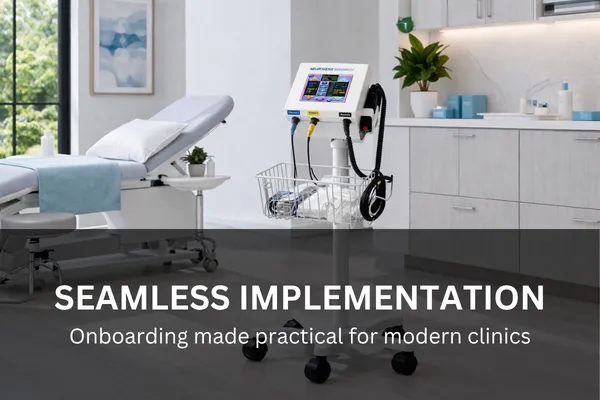
How Practices Add Neurogenx Without Disrupting Workflow
For many providers, interest in neuropathy treatment is not the issue.
The issue is implementation.
A practice may see the clinical need. It may understand the growing demand from patients with burning, tingling, numbness, balance issues, chronic nerve pain, or diabetic complications. It may even believe that offering a more advanced, non-invasive option could strengthen both patient care and practice positioning.
But one practical question tends to slow everything down:
How hard is this actually going to be to add?
That is the right question to ask.
Because no matter how promising a treatment sounds on paper, adoption becomes far less likely if the program feels operationally heavy, difficult to train, or disruptive to an already busy clinic schedule. Providers are not just evaluating clinical relevance. They are evaluating whether a new service can fit the real rhythm of the practice.
That is exactly why implementation matters.
This is not about hype. It is not about grand promises. It is about making adoption feel operationally clear, practical, and manageable.
The Real Barrier Is Often Not Belief. It Is Friction.
Providers rarely say no to a promising opportunity because they dislike better patient care.
More often, they hesitate because they are imagining friction.
They are thinking about staffing. Scheduling. Team buy-in. Room flow. Training time. Patient handoffs. Day-to-day execution. They are asking themselves whether the addition will create complexity that outweighs the upside.
Those concerns are not signs of resistance. They are signs of responsible evaluation.
And they should be addressed directly.
The right implementation conversation is not:
“Can your practice work harder?”
It is:
“Can this program work well inside the way your practice already operates?”
Why Implementation Matters as Much as Innovation
Providers are not necessarily looking for another piece of equipment, another random add-on, or another service that only works in theory. They are looking for something that can fit into real schedules, with real teams, inside real practices.
That means implementation matters just as much as innovation.
A neuropathy-focused program has to do more than sound clinically interesting. It has to feel workable. It has to feel trainable. It has to feel repeatable. And ideally, it should create more structure rather than more confusion.
This is where Neurogenx becomes easier to evaluate.
Instead of being framed as a vague “extra treatment,” it is better understood as a structured neuropathy program—something that can be onboarded with clarity, supported with resources, and integrated into a defined care model.
What Onboarding Actually Needs to Accomplish
Providers do not just want reassurance. They want a path.
A strong onboarding process should help a clinic answer a few essential questions early:
Who on the team needs to understand the program first?
What does the workflow look like from patient identification to treatment delivery?
How should scheduling be approached at the beginning?
What training or support materials are available?
What does success look like in the first few weeks?
When onboarding is handled well, implementation becomes far less intimidating.
The objective is not to overwhelm a provider with technical information or make the launch feel like a major operational event. The objective is to create confidence. A clinic should come away feeling that the program has a logical rollout path, that the team can understand it, and that support exists beyond the initial conversation.
What Staff Need to Know Before Launch
Staff readiness is one of the most important parts of successful implementation.
Many provider decisions fail or stall not at the doctor level, but at the team level.
If the staff does not understand how a new program fits into the day, the service can feel awkward from the start. If team roles are unclear, scheduling becomes inefficient. If no one knows the patient handoff points, consistency suffers. If there is no shared language around the treatment process, the patient experience becomes less confident.
What staff need most before launch is not complexity. It is clarity.
They need to know:
where the program fits in the patient journey,
what their role is,
what the treatment rhythm looks like,
how to speak about it consistently,
and how the practice will keep delivery smooth and repeatable.
When that clarity is present, implementation feels less like a burden and more like a system.
The Most Common Rollout Mistakes Are Usually Operational
One of the most useful ways to think about implementation is to focus on what can go wrong early—and avoid it before it starts.
In many clinics, rollout mistakes are not dramatic. They are small operational gaps that create unnecessary drag.
Examples include:
launching without a clear workflow owner,
failing to define staff roles,
underestimating scheduling rhythm,
treating the service like a one-off offering instead of a structured program,
or waiting too long to equip the team with the right resources and talk-tracks.
Prospective providers are not only evaluating the technology. They are evaluating the support structure around it. They want to know whether there are protocols, training pathways, documentation tools, and implementation guidance that make launch feel realistic.
That is what separates a promising idea from a practical addition to the practice.
What the First 30 Days Should Look Like
A provider does not need to imagine a massive expansion on day one. In fact, the first month should usually be viewed as a clarity-building phase.
The goal of the first 30 days is not perfection. The goal is rhythm.
In that first month, a practice should be working toward:
understanding the workflow,
aligning staff roles,
building confidence in delivery,
creating a repeatable patient process,
and identifying where the program fits most naturally in the clinic schedule.
The goal is not to force a new system into the practice. The goal is to make the program feel workable inside the system the clinic already has.
A strong first 30 days should make the service feel less foreign and more familiar. By the end of that period, the team should not be asking, “Can we do this at all?” They should be asking, “How do we keep improving this process?”
That shift is what turns interest into adoption.
Why This Matters for Providers Exploring Neurogenx
For many non-owner prospects, this is the stage where real interest either grows or fades.
Most already understand that neuropathy is a significant category. Many already believe better differentiation could help their practice. What they need next is confidence that launch does not have to feel chaotic.
That is why implementation is such an important part of the conversation.
A program like Neurogenx should not feel like operational disruption disguised as innovation. It should feel like a structured addition that can be onboarded with clarity, supported by the right resources, and introduced in a way that respects the realities of a busy clinical practice.
That is what providers are really looking for.
Not more complexity.
Something that fits.
The Bottom Line
The providers most likely to adopt successfully are not the ones chasing the newest thing just because it sounds exciting. They are the ones looking for something clinically relevant, operationally practical, and easy enough to integrate with confidence.
When a neuropathy-focused program fits the rhythm of the clinic, implementation stops feeling like a risk and starts feeling like a next step.
And that is the difference between curiosity and action.
Call to Action
If you are evaluating whether a neuropathy-focused program could fit your practice, now is the right time to look at the implementation side more closely.
Connect with the Neurogenx team to learn how onboarding, staff workflow, and early rollout planning can support a smoother launch—and see how Neurogenx could fit into your existing practice model.