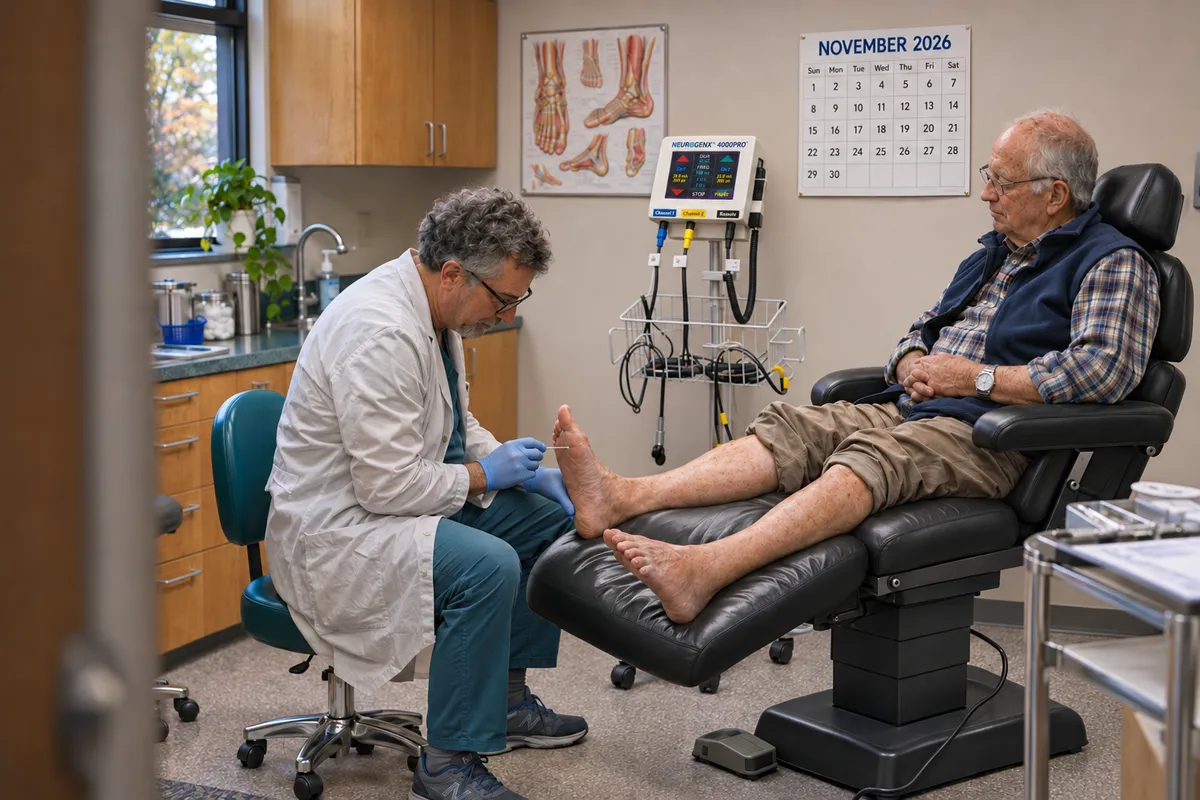
The Neuropathy Conversation That Shouldn't Wait for the Next Diabetic Foot Exam
Clinical focus: Early recognition, risk stratification, and continuity of care
For podiatrists, identifying diabetic peripheral neuropathy is rarely the difficult part of the encounter.
The findings may already be familiar: diminished protective sensation, altered vibration perception, persistent burning, or sensory changes that have progressed gradually enough for the patient to consider them normal.
The examination establishes what we need to know.
But an important question follows:
What actually changes in the patient's care once neuropathy has been identified?
As World Diabetes Day approaches on November 14, the 2026 theme, Early Action on Diabetes, offers an opportunity to consider a distinction that matters in established podiatry practices.
Early detection is essential. But detection and intervention are not the same achievement.
For patients with diabetic peripheral neuropathy, the value of recognizing nerve dysfunction depends partly on what happens next.
A Positive Finding Should Change the Care Pathway
Neuropathy screening is an established component of diabetes care. Experienced podiatrists already understand the importance of evaluating protective sensation, identifying foot-related risks, and monitoring patients over time.
The challenge is translating those findings into a care pathway that reflects the patient's actual risk and needs.
Consider two patients with documented peripheral neuropathy.
One reports intermittent burning but retains protective sensation and has no history of foot complications.
The other reports little discomfort, has significant sensory loss, and has developed areas of repetitive pressure that require ongoing attention.
Both carry a neuropathy diagnosis.
Their management priorities, however, should not be identical.
The diagnosis identifies the condition. The clinical findings should determine what happens next.
That distinction becomes increasingly important when neuropathy is treated as a continuing clinical problem rather than a finding addressed only during a scheduled diabetic foot examination.
The Absence of Pain Is Not Evidence of Stability
One of the more consequential challenges in diabetic neuropathy care is that symptoms and risk do not always move together.
A patient may describe severe burning while retaining substantial protective sensation.
Another may report minimal discomfort despite clinically significant sensory loss.
The 2026 American Diabetes Association Standards of Care note that up to half of diabetic peripheral neuropathy cases may be asymptomatic.
For podiatrists, this reinforces a familiar but important point: the patient's description of pain cannot independently establish the extent of nerve dysfunction or the level of foot-related risk.
It also raises a practical question about follow-up.
If pain is the primary reason a patient seeks treatment, what happens when pain is absent but the clinical findings remain concerning?
A meaningful neuropathy pathway must account for both presentations.
The objective is not simply to document whether symptoms are present. It is to identify what those symptoms—or their absence—mean for ongoing care.
Screening Is a Moment. Neuropathy Management Is a Continuum.
The annual diabetic foot examination provides a structured opportunity to identify neuropathy and associated complications.
But the clinical needs identified during that examination may extend well beyond a single visit.
Loss of protective sensation, progressive sensory changes, foot deformity, peripheral arterial disease, and a history of ulceration can influence the intensity of surveillance and the interventions required.
The ADA's 2026 Standards of Care recommend risk-based follow-up, with more frequent examinations for patients at higher risk.
For an established podiatry practice, the opportunity is to ensure that those risk categories translate into consistent clinical processes.
That may include:
Defined follow-up intervals based on risk and clinical findings
Documentation of sensory and functional changes over time
Appropriate footwear, offloading, and preventive foot-care strategies
Coordination with the patient's broader diabetes-care team
Reassessment of persistent neuropathic symptoms and treatment response
The individual elements are familiar.
What deserves attention is how reliably they connect.
A structured care pathway gives the initial examination lasting clinical value.
When the Patient's Symptoms and Clinical Findings Tell Different Stories
Diabetic peripheral neuropathy does not present as a single, predictable progression.
Some patients seek care primarily because of pain. Others become aware of neuropathy only after changes in sensation or the development of foot-related complications.
That variability creates an important distinction between managing symptoms and managing risk.
Pain relief may improve a patient's quality of life without restoring protective sensation.
Likewise, a patient with little or no pain may still require intensive preventive care because of sensory loss and other risk factors.
For this reason, treatment response should not be interpreted through one measure alone.
A more complete evaluation considers whether the intended treatment goal is symptom relief, reduction of foot-related risk, improved daily function, or another clinically appropriate objective.
These goals may overlap, but they are not interchangeable.
And no single intervention should be expected to address all of them.
Where Additional Treatment Options May Fit
For patients experiencing persistent neuropathic symptoms, the care pathway may also involve evaluating additional treatment approaches.
That evaluation should begin with the diagnosis, contributing conditions, prior treatment response, and the patient's individual goals.
The Neurogenx 4000PRO with NervePro 2.0 offers providers an additional technology-based option to consider within an established neuropathy program.
Using Electronic Signal Treatment (EST), the system delivers electronic signals through electrodes positioned according to a clinician-directed treatment plan.
Its potential role should be considered alongside established medical management, preventive foot care, and other appropriate interventions—not as a replacement for them.
Neurogenx also provides clinical education, treatment protocols, staff training, implementation resources, and continuing support through its PLUS Programs.
For podiatrists, the operational consideration is significant.
Adding a treatment modality is most useful when the practice has a consistent process for identifying appropriate candidates, delivering care, and monitoring the outcomes that the treatment is intended to address.
Treatment-specific efficacy claims should be evaluated against the device's authorized indications and supporting clinical evidence.
Early Action Should Mean More Than Early Identification
World Diabetes Day encourages earlier recognition and action to reduce the burden of diabetes and its complications.
For podiatrists, that message has a particularly relevant application.
A neuropathy diagnosis should not become a static entry in the medical record.
It should inform surveillance, patient education, preventive care, symptom management, and the decisions that follow as the patient's condition changes.
The goal is not to create more visits or add interventions without a clear indication.
It is to ensure that the findings we identify lead to care that is appropriately responsive.
The most meaningful neuropathy screening is not simply the one that detects a problem early. It is the one that changes what happens next.
Strengthening the Neuropathy Care Pathway
For practices reviewing how they evaluate and manage peripheral neuropathy, Neurogenx offers an opportunity to explore an additional treatment modality supported by clinical training, implementation resources, and ongoing program support.
Learn more about the Neurogenx 4000PRO and how it may complement your existing neuropathy services.
Clinical note: Management of diabetic peripheral neuropathy requires individualized assessment and appropriate management of underlying conditions and complications. Neurogenx treatment should not be represented as restoring protective sensation, preventing diabetic foot ulcers, or reversing diabetic nerve damage without indication-specific supporting evidence.