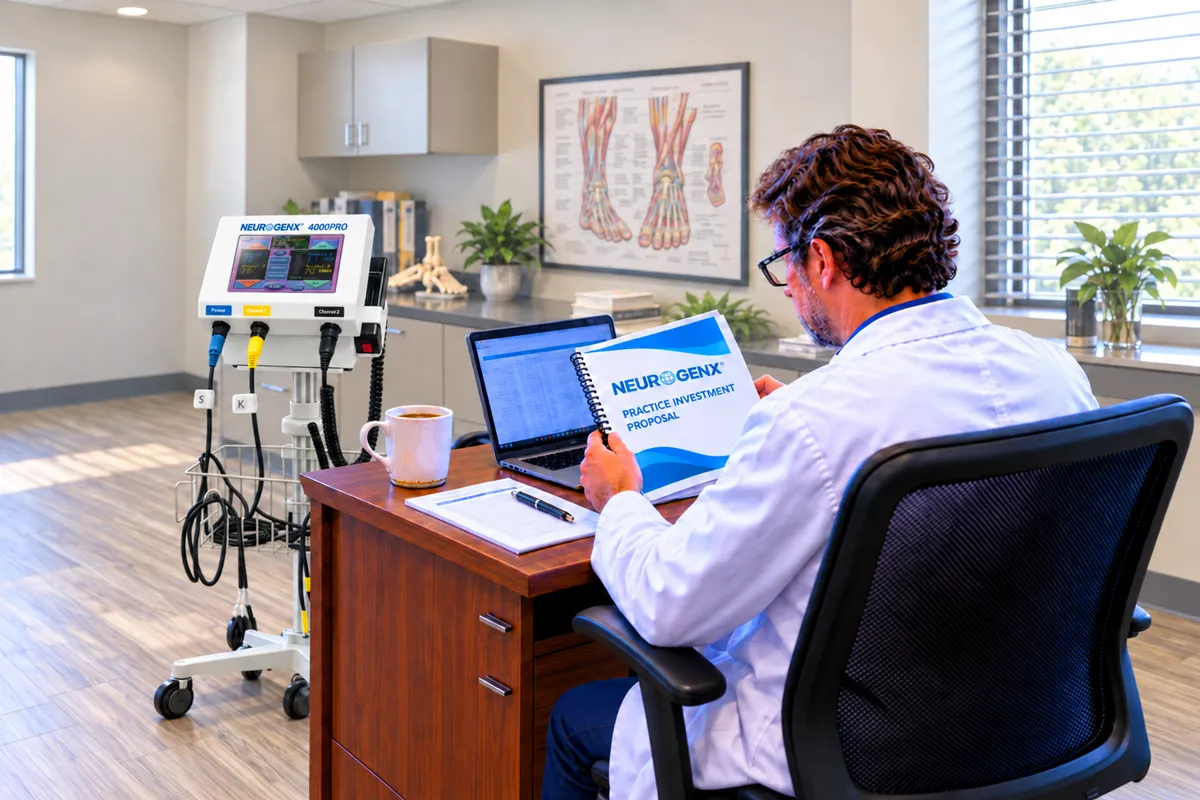
The Year-End Investment Question: What Does Waiting Really Cost Your Practice?
Every fourth quarter, practice owners revisit familiar questions.
Which investments have delivered value? Which priorities deserve greater attention? And which decisions should move forward before another year begins?
For experienced podiatrists, the most consequential question may not be whether the practice needs another piece of equipment.
It may be whether a clinical investment already under consideration has a compelling reason to remain on hold.
That distinction matters when evaluating additional treatment capabilities for peripheral neuropathy.
The clinical need does not emerge because the calendar reaches October. The patients are already in the practice. The persistent symptoms, treatment limitations, and questions about next steps are already part of the clinical conversation.
What changes near year-end is the opportunity to examine an established priority through a different lens: clinical value, operational readiness, and financial timing.
A Decision to Wait Is Still a Practice Decision
Capital investments are often evaluated by asking whether the practice is ready to proceed.
That is appropriate.
But an equally useful question is whether postponement has been examined with the same rigor.
There may be good reasons to defer an acquisition. The patient population may not justify it. Staffing may be constrained. The technology may not fit the practice's current treatment model.
Those are substantive reasons.
But when a practice has already identified a clinical need, a suitable patient population, and a plausible path to implementation, waiting deserves its own rationale.
What would be different in the next planning cycle?
Would the practice have better evidence, greater operational capacity, or a more appropriate patient population?
Or would the same clinical questions remain unanswered?
Deferral should be an informed strategy, not simply the absence of a decision.
This is particularly relevant when neuropathy patients continue to report symptoms despite appropriate treatment.
For a closer look at that clinical challenge, read When Neuropathy Patients Are Still in Pain: Is Your Treatment Pathway Giving You Enough Options?.
The Clinical Timeline and the Financial Timeline Are Not the Same
A clinical technology investment is evaluated over its useful life.
Its value depends on appropriate patient selection, clinical utility, staff adoption, treatment delivery, and whether it serves a defined role within the practice.
The financial treatment of that investment may follow a different timeline.
Federal tax provisions, including Section 179 and bonus depreciation, may allow qualifying business equipment costs to be deducted sooner than they would be under ordinary depreciation schedules.
That possibility does not make an acquisition clinically appropriate.
Nor does it mean that every equipment purchase qualifies for the same treatment.
But it does introduce a consideration that may be overlooked when a practice evaluates an acquisition solely by its purchase price.
The cost of acquiring equipment and the after-tax cost of a qualifying investment are not necessarily identical.
For a practice that has already established a sound clinical and operational rationale, that distinction may influence the timing of its decision.
Tax eligibility, the appropriate depreciation method, and the potential benefit must be determined by a qualified tax adviser.
The Better Question Is Not “What Can We Deduct?”
Year-end equipment discussions often begin with tax incentives.
For an established podiatry practice, that reverses the appropriate order of evaluation.
The more useful starting point is whether the proposed investment addresses a meaningful need within the existing care pathway.
Consider patients whose neuropathic symptoms persist despite appropriate evaluation and treatment.
Some may benefit from reassessment of the diagnosis or contributing conditions. Others may require changes in symptom management, additional preventive care, or referral.
For selected patients, an additional treatment modality may warrant consideration.
The practice's responsibility is not to offer every available intervention.
It is to understand which options are appropriate, what each is intended to accomplish, and how outcomes will be evaluated.
That is the clinical foundation of an investment decision.
The tax discussion belongs afterward.
For additional context, explore Why Mobility, Balance, and Function Matter as Much as Pain in Neuropathy Care. It examines why treatment goals should reflect more than symptom intensity alone.
Where Neurogenx Fits Into the Evaluation
For practices considering additional neuropathy treatment capabilities, the Neurogenx 4000PRO with NervePro 2.0 offers a technology-based modality to evaluate within an established clinical program.
The system delivers Electronic Signal Treatment (EST) through electrodes positioned according to a clinician-directed treatment plan.
Its potential role should be considered in relation to the patient's diagnosis, appropriate selection criteria, authorized device indications, available clinical evidence, and existing treatment options.
Neurogenx is not a substitute for managing underlying conditions or providing established preventive and supportive care.
The investment also involves more than the equipment itself.
Through the Neurogenx PLUS Programs, participating practices receive access to clinical education, treatment protocols, staff training, implementation resources, and continuing program support.
For practice owners, those resources are relevant because acquiring technology and integrating it effectively are different undertakings.
A device can be clinically appropriate yet difficult to incorporate without a clear operational plan.
The value of an additional treatment capability depends not only on what the technology can do, but on whether the practice can use it consistently and responsibly.
For a related operational perspective, read How Practices Add Neurogenx Without Disrupting Workflow. This article explores the practical considerations involved in integrating another neuropathy service into an established practice.
Year-End Planning Makes Readiness More Important
The timing of an acquisition can affect its tax treatment.
For federal depreciation purposes, equipment generally must be placed in service—ready and available for its intended business use—during the applicable tax year.
A signed purchase agreement or payment made before year-end does not necessarily satisfy that requirement.
This distinction makes operational planning part of the financial discussion.
A practice considering a Neurogenx acquisition should evaluate delivery, setup, training requirements, and the steps necessary to make the equipment ready for its intended use.
Not every aspect of broader program development must necessarily be completed before equipment is considered placed in service. The relevant determination depends on the facts and applicable tax rules.
The practice's tax adviser should assess those requirements independently of the clinical and implementation review.
The objective is not to accelerate an acquisition without adequate preparation.
It is to understand whether an otherwise justified investment can be implemented on a timeline that makes sense clinically, operationally, and financially.
The Most Important Year-End Question May Already Have an Answer
Experienced podiatrists do not need another reminder that capital expenditures should support the practice's long-term direction.
The more valuable exercise is identifying which clinical priorities have already earned serious consideration—and understanding why they remain unresolved.
If a practice continues to encounter patients with persistent neuropathic symptoms, it may be worth revisiting whether the existing treatment pathway provides sufficient flexibility.
If an additional modality appears clinically appropriate, the next question is whether it can be integrated effectively.
If the operational case is sound, the financial conversation can include how acquisition timing and applicable tax provisions affect the investment.
Each question leads naturally to the next.
A worthwhile investment should make sense without a tax incentive. But a potentially favorable tax treatment may change when it makes sense to proceed.
That is the year-end opportunity worth examining.
Not a reason to purchase equipment simply because the calendar is changing.
A reason to revisit a decision the practice may already be prepared to make.
Continue Exploring the Clinical and Practice Considerations
Before evaluating an additional neuropathy treatment platform, consider the questions that shape its place in your practice:
What options remain when neuropathy patients continue to experience pain?
What does a structured neuropathy program need to operate effectively?
When those questions point toward evaluating another modality, explore the Neurogenx 4000PRO and its provider implementation programs at Neurogenx Provider Solutions.
Tax note: This article is for general educational purposes and does not constitute tax, legal, or accounting advice. Section 179 and bonus depreciation eligibility, deduction timing, and applicable limitations depend on current law and individual circumstances. Consult a qualified tax professional before making an equipment acquisition or claiming a deduction.
Clinical note: Treatment selection should be individualized and supported by the device's authorized indications and relevant clinical evidence. No specific patient outcome, restoration of nerve function, or financial return is guaranteed.