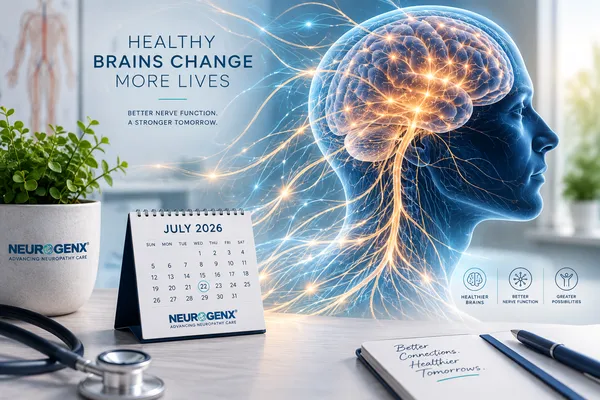
Brain Health Is More Than the Brain: Why Peripheral Nerve Function Matters
When providers think about brain health, the conversation often starts with cognition.
Memory. Focus. Stroke. Neurodegenerative disease.
But neurological health does not stop at the brain.
Every step a patient takes, every surface they feel beneath their feet, and every adjustment they make to remain upright depends on communication across the nervous system.
That includes the peripheral nerves.
As World Brain Day brings neurological health into focus this July, there is an opportunity for providers to consider a broader question:
How well is the nervous system communicating from the brain to the body—and back again?
For practices treating peripheral neuropathy, that question matters.
The Brain Depends on Information From the Body
The brain is constantly receiving information.
Sensory receptors detect pressure, touch, temperature, vibration, movement, and position. Peripheral nerves carry those signals toward the spinal cord and brain, where they are interpreted and used to guide movement and response.
Most of this happens without conscious thought.
A patient simply stands.
Walks.
Turns.
Steps onto an uneven surface.
But when peripheral nerve function is impaired, some of that sensory information may become diminished or distorted.
The result may be more than pain.
Patients may experience numbness, altered sensation, weakness, changes in movement, or a growing sense that their feet are no longer giving them reliable information.
That is why peripheral nerve health belongs in the broader neurological conversation.
What Does Peripheral Neuropathy Have to Do With Brain Health?
Peripheral neuropathy affects nerves that carry information between the central nervous system and the rest of the body. When those signals are disrupted, patients may experience changes in sensation, movement, and daily function—even when pain is not their primary concern.
The distinction is important.
Peripheral neuropathy is not a disease of the brain.
And providers should not imply that treating peripheral neuropathy prevents dementia, improves cognition, or treats central neurological disease.
The connection is simpler—and clinically important.
The brain relies on information coming from the peripheral nervous system.
If that information changes, the way a patient interacts with the world around them can change too.
Pain Gets Attention. Sensory Loss Can Be Quieter.
Pain is easy for patients to recognize.
Burning hurts.
Pins and needles are noticeable.
Electric or shooting sensations get attention.
Sensory loss can be much quieter.
A patient may gradually start watching their feet while walking.
They may use a railing more often.
They may become more cautious on stairs or uneven ground.
They may simply say:
“My feet don’t feel like they used to.”
These small comments can reveal something a pain score may not.
For providers, the clinical conversation should therefore extend beyond:
“How much does it hurt?”
It should also include:
“What has changed in the way you move, feel, or function?”
Proprioception Makes the Connection Easier to See
One useful example is proprioception—the body’s ability to recognize its position and movement in space.
Patients normally do not need to look down to know where their feet are.
Sensory information from the body helps provide that awareness.
The brain then combines that information with visual and vestibular input to help coordinate movement and postural control.
When peripheral sensory input becomes less reliable, patients may compensate in subtle ways.
They may depend more heavily on vision.
Move more cautiously.
Or become less confident in environments where sensory demands are higher.
For providers, this reinforces an important point:
The functional impact of neuropathy may appear before the patient has the clinical language to describe it.
A More Complete Neuropathy Assessment Looks Beyond Symptoms
Pain scores still matter.
But pain alone does not tell providers how effectively the nervous system is functioning.
Depending on the patient and the provider’s scope of practice, a more complete neuropathy evaluation may consider:
· sensory changes,
· vibration or protective sensation,
· strength and reflexes,
· gait,
· stance and stability,
· functional mobility,
· and changes in daily activity.
The goal is not simply to document what the patient feels.
It is to understand what nerve dysfunction is changing.
That can reveal a very different clinical picture.
A patient with relatively little pain may still be experiencing meaningful sensory or functional limitations.
Why This Matters During World Brain Day
The World Federation of Neurology’s 2026 World Brain Day theme is “Brain Health: Access for All.”
For providers, that message offers a useful reminder: neurological care is not limited to a single organ, symptom, or diagnosis.
The nervous system is interconnected.
The brain processes.
The spinal cord relays.
Peripheral nerves communicate.
Sensory receptors detect.
Muscles respond.
And when communication along that pathway becomes impaired, patients may begin adapting their lives around those changes.
Recognizing those changes early can lead to a more meaningful clinical conversation.
Where Neurogenx Fits
For practices evaluating a more comprehensive approach to peripheral neuropathy, Neurogenx provides Electronic Signal Treatment (EST) as part of an individualized neuropathy care strategy.
EST is delivered using Neurogenx electromedical technology and offers providers a non-narcotic, non-surgical treatment option to consider for appropriate patients.
But technology should not replace thoughtful evaluation.
It should support it.
A stronger neuropathy program begins by understanding the patient more completely:
· What are they feeling?
· What are they no longer feeling?
· Has the way they move changed?
· What activities have become more difficult?
· What outcomes matter most to them?
Those questions help providers move beyond a symptom-only conversation toward a broader view of nerve function and patient care.
The Bigger Neurological Question
Brain health deserves attention.
So does the neurological network that keeps the brain connected to the rest of the body.
For providers treating peripheral neuropathy, July is an opportunity to ask a bigger question:
How well is this patient’s nervous system communicating—and what is changing when that communication becomes impaired?
The answer may reveal more than a pain score ever could.
Take the Next Step
If your practice is seeing more patients with burning, tingling, numbness, sensory changes, or functional concerns, consider whether your current neuropathy pathway looks beyond symptoms alone.
Explore how Neurogenx can support a more comprehensive approach to peripheral neuropathy care through treatment technology, provider education, and practice implementation support.